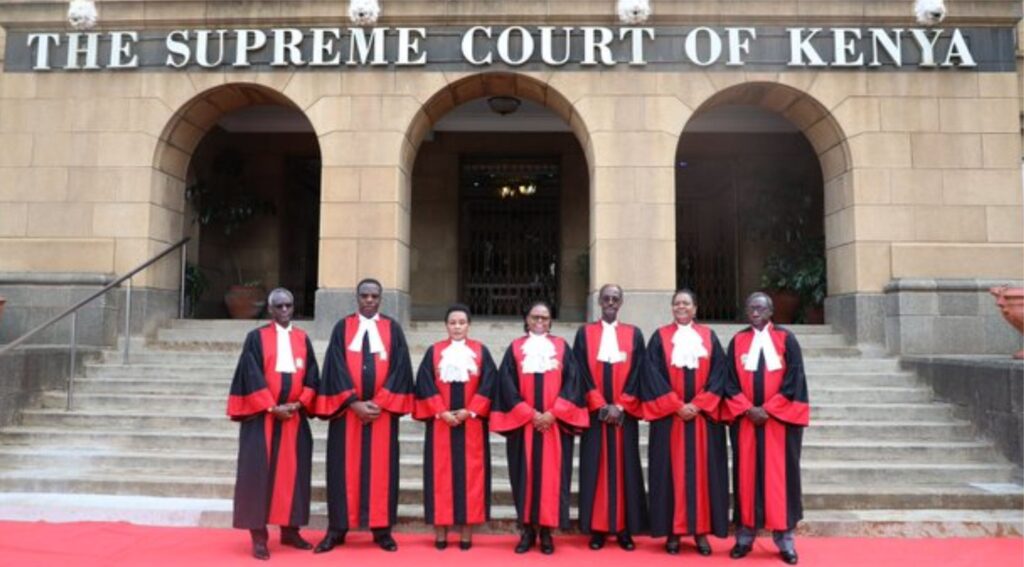
On the morning of June 30th, 2025, something profound and unsettling rippled across Kenya’s legal and spiritual landscape. It didn’t come with riots or gunshots, nor did it bear the obvious marks of political upheaval. It came dressed in formal judicial language, cool, sterile, cloaked in constitutional jargon. But for those who understand the weight of faith, for those who know what it means to live in obedience to divine law, the impact was no less than that of a thunderclap. The shock reverberated through mosques, households, and communities like a cold wave crashing through sacred ground.
On that morning, the Supreme Court of Kenya, the apex court charged with safeguarding the Constitution and respecting the diverse faiths that form this nation’s soul, handed down a ruling that will live in infamy for millions of Muslim Kenyans. In Supreme Court Petition No. E035 of 2023: Fatuma Athman Abud Faraj v Ruth Faith Mwawasi & Others, the Court declared that Muslim children born out of wedlock must be allowed to inherit from their deceased fathers. This decision was framed as a victory for equality and human rights, but beneath the surface, it pierced through the very heart of Islamic jurisprudence. Because in doing so, the Court directly contradicted centuries of well-established Islamic law, which draws clear lines on matters of inheritance and lineage, lines not drawn by men, but by Allah Himself.


For Muslims, this was not just a court case. It was not a technical debate on statutory interpretation. It was an earthquake, a spiritual rupture, tearing through one of the most sacred areas of Islamic belief: the divine command on how wealth must be distributed after death. Inheritance in Islam is not a matter of societal consensus or evolving morality. It is not left to human preference or cultural tides. It is one of the few aspects of life that Allah meticulously detailed in the Qur’an, with specific shares designated to heirs. To override that system is not merely an error in judgment, it is an offense against the very sanctity of faith.
This ruling did not come from nowhere. It did not appear out of the blue. Rather, it follows years, perhaps decades, of growing tension between the Kenyan judiciary and the Muslim community. A pattern is beginning to emerge, one that deeply alarms believers who have long trusted in the promise that this nation would protect not only their right to exist but their right to live fully by their faith. From previous rulings that undermined the right of Muslim girls to wear the hijab in schools, to a judiciary increasingly inclined to view religious conviction through the lens of “reasonable limitations,” the signs have been building. Quietly. Consistently.
This case is the culmination of that pattern. It is the moment those simmering concerns have erupted into open anguish. It is the point where tolerance has been tested beyond its limits, where constitutional guarantees are no longer being tested, they are being trampled.
Let us be very clear: this is not simply about legal disagreement. It is not the ordinary tension between church and state, faith and law. No. What we are witnessing is a fundamental breach of trust between the State and the Muslim community, a breaking of a sacred promise written into the very charter of our republic. Article 24(4) of the Constitution was not inserted on a whim. It was placed there as a reassurance, as a recognition of the unique religious obligations that guide Muslims in matters of personal status, specifically, in marriage, divorce, and inheritance. It was a constitutional bridge between the secular and the sacred. Now, that bridge has been set ablaze.
To override Islamic inheritance law is not just to reinterpret legislation, it is to dismantle the pillars of divine command. It is to say, with finality, that God’s law can be overruled by man. It is to inform millions of faithful Muslims in this country that the Qur’an no longer has authority in matters where the Constitution once promised it would. It is to place the judgment of unelected judges above the word of the Almighty.
And that is why the pain cuts so deep.
This is not just about children. It is not about equality. It is about the role of faith in a nation that claimed to embrace all. It is about the survival of religious autonomy in a legal system now willing to question the very texts that define that faith. It is about whether Muslims can continue to live in this land as Muslims, not only in name but in practice. It is about whether divine law will be protected or progressively erased under the pretense of modern jurisprudence.
The betrayal is not in the ruling alone. It is in the tone. In the assumption that the Court understands Islam better than the scholars. That constitutional interpretation now includes theological reform. That equality demands uniformity, even when uniformity violates the soul of a people’s belief. This is no longer legal overreach. It is spiritual trespass.
This decision has sent shockwaves throughout the Ummah. It has shaken trust in the judiciary. It has lit a fire beneath legal scholars, sheikhs, constitutionalists, and everyday Muslims who now ask, if this right can be stripped, what next? Will our weddings be invalidated? Will our mosques be regulated? Will our madrasas be judged inadequate? The slope is no longer slippery, it is steep, and we are already sliding.
No, this ruling did not arrive in a vacuum. It is part of a calculated shift, and we are not mistaken in calling it what it is: a betrayal.
This is not justice. It is betrayal.
Not just of Muslims.
Not just of Islamic law.
But of the Constitution itself, and of the fragile peace it promised between Kenya’s secular governance and its religious diversity.
Article 24(4): A Promise Made, A Promise Broken
When the people of Kenya went to the ballot in 2010 to adopt a new Constitution, it was not just a vote for legal reform, it was a collective leap of faith into a future that promised inclusivity, justice, and dignity for all. It was a moment of national rebirth. After years of political strife, ethnic divisions, and the bruises of colonial legacy, Kenya stood at a historic crossroads. And in that moment, we chose to become a nation not defined by sameness, but by the strength of our diversity.
The 2010 Constitution was hailed across Africa and beyond as a bold, transformative charter. It was described as one of the most progressive in the world. But it was not progressive because it demanded uniformity. It was progressive because it acknowledged and celebrated difference. It carved out space for every community to live fully, faithfully, and freely. And for Muslims, it offered something deeply profound: dignity in difference.
At the heart of that promise was Article 24(4), a solemn recognition that Muslims in Kenya do not just live by a different culture, but by a divinely ordained way of life. It was a declaration written in legal ink, but inscribed in the hearts of millions: that their religious laws, as revealed by Allah, would not be trampled by the mechanisms of state. That in matters deeply personal, marriage, divorce, and inheritance, they would be judged not by secular metrics, but by the timeless guidance of Shariah.
Let us reflect on the exact words of this sacred clause:
“The provisions of this Chapter on equality shall be qualified to the extent strictly necessary for the application of Muslim law before the Kadhis’ courts, to persons who profess the Muslim religion, in matters relating to personal status, marriage, divorce and inheritance.”
This was not an afterthought. It was not a gap or a loophole. It was not a favour extended to appease the coastal vote. It was a constitutional covenant, a deliberate safeguard constructed with wisdom and historical consciousness. It was an acknowledgment that the secular law must sometimes step aside, not to discriminate, but to protect the religious autonomy of a minority with centuries of uninterrupted legal tradition.
Article 24(4) stood as a wall, a protective barrier, against the erosion of Muslim identity. It offered assurance that no matter the winds of political change, the tides of modern legal interpretation, or the passions of populist reform, there would remain a sanctuary in the law for Muslims to live as they are commanded. It was the living proof that Muslims were not merely being tolerated, they were being respected.
But now, that promise lies shattered.
With the Supreme Court’s ruling of June 30th, 2025, this solemn assurance has been betrayed. The carefully drawn line between divine command and secular enforcement has been smeared. And the community that once felt safe under the canopy of constitutional protection now finds itself exposed, its values questioned, its rights diluted, its identity on trial.
The ruling does not just disregard Islamic inheritance law. It overrides it. It strips it of its legitimacy, and in doing so, it sends a chilling message: that the divine guidance Muslims have followed for centuries is no longer worthy of legal respect in Kenya.
Is this not betrayal?
For Muslims, this ruling cut far deeper than legal debate. It signals that the Constitution, once a guardian of their faith, is now being wielded as a tool to reshape that faith, to conform it, dilute it, and eventually, erase it.
The pain of this breach is made all the more intense by the knowledge of what Article 24(4) meant. It was our shield. Our guarantee. Our anchor in a country that has often misunderstood us, marginalized us, and misrepresented us. It was our place in the national fabric, our recognition as a people not just with rights, but with sacred responsibilities.
To see that anchor uprooted, to watch that shield crumble under the gavel of the Supreme Court, is not just a legal loss, it is a spiritual wound.
What do we make of a constitution that promises protection but permits violation? What is the value of a right that can be taken away by judicial fiat? If Article 24(4) can be bypassed in the name of equality, then what meaning does it truly hold?
This is not theoretical. This is not abstract. This is the lived reality of millions who now feel that their faith, once respected, is being gradually forced into conformity. That the right to be different is slowly becoming the duty to comply.
And so we say, without hesitation: this was a promise made, but now, it is a promise broken.
What is lost here is not only a legal protection. What is lost is trust. Trust in the Constitution. Trust in the judiciary. Trust in the system that claimed to honor our identity, but now seeks to rewrite it.
The Supreme Court’s Invasion into Sacred Ground
There are moments in the life of a nation when the courts do not simply rule on the law, they redefine the moral and spiritual architecture of the society. And when they do so without caution, without reverence for the sacred, without acknowledgment of the divine, they do not render justice, they commit desecration. The Supreme Court’s ruling of June 30th, 2025, is not merely a judicial opinion. It is not a clarification of rights. It is an invasion into sacred space, into a place where only Allah has authority. A place where the law of man was never meant to interfere.
Let us not be deceived by the measured language of the ruling, by the polished legalese, or by the academic elegance with which it was penned. Beneath that calm surface lies an act of unprecedented overreach. The Court, in the name of constitutional equality, has walked into the holiest chambers of Islamic law, into inheritance, a matter where Allah Himself laid down explicit guidance, and rewritten what was never theirs to touch.
Inheritance, in Islam, is not like other legal matters. It is not a human construct developed through custom or consensus. It is a divine command, with fixed portions revealed in the Qur’an, detailed in a way no other area of Islamic law has been. The Qur’an does not offer suggestions on inheritance; it lays down obligations. It assigns shares. It defines categories. It closes doors. It protects the sanctity of lineage and family structure as Allah, not man, designed it.
To disregard that, or to alter it under the pretence of fairness or progress, is to place human judgment above divine revelation. It is to say, in effect, that the values of modernity are superior to the values of revelation. That the will of Allah is outdated, and must now be made to conform to the standards of constitutional convenience.
This is not judicial review. This is theological revisionism.
What the Court has done, in this case, is far beyond interpretation, it is a declaration of spiritual supremacy. The justices have presumed the authority to determine that the Islamic rules of inheritance are discriminatory, and therefore must be “read down,” diluted, or overruled. But this judgment does not only apply to the parties involved, it sets a precedent that shakes the very foundation of religious law in Kenya.
And we must ask: Who gave them this authority?
Not the Constitution. Article 24(4) is clear in protecting Islamic personal law. Not Parliament, this was not a legislative amendment. Not the people, this issue was never subjected to a referendum, a constitutional convention, or a national conversation. No, this decision came from the bench alone, from five human beings cloaked in robes, wielding pens more powerful than missiles, and striking at beliefs more enduring than marble courts.
To say Muslims must now allow what Allah has forbidden is not neutrality. It is not protection. It is persecution in disguise. It is the slow boiling of a frog in water, gradual, silent, lethal. It is the tyranny of the robe, cloaked in the language of rights, stripping away the very right to be governed by divine command.
The Supreme Court, in reaching this decision, claimed to balance religious freedom with the constitutional principle of non-discrimination. But the balance it struck was not a careful harmony, it was a forced equality that ignores the very essence of faith. Islamic law is not based on human logic; it is based on submission. “Islam” itself means submission to the will of Allah. And when the Court insists that Muslims must conform their divine laws to secular ideals, it is no longer mediating between competing rights, it is choosing sides.
And tragically, it has chosen to side against Islam.
This ruling tells us that our sacred boundaries are no longer safe. That the Court may now walk into the house of Islam, uninvited, and rearrange its furniture. That it may rewrite rules carved into the Qur’an. That it may override centuries of jurisprudence, generations of tradition, and millennia of unbroken transmission of sacred knowledge, all in the name of a new moral order.
This is not equality. This is not protection. This is colonization of belief, not by the sword, not by the ballot, but by the gavel.
And what does it mean for tomorrow?
Today, it is inheritance. Tomorrow, will it be polygamy? Will the Court decide that a man cannot marry more than one wife because it offends gender equity? Will they rule that the mahr, the dowry a husband gives to a wife, constitutes economic inequality? Will they enter the mosque next, demanding that sermons conform to secular values? Will the madrasa be told what to teach and what to forget?
If the courts can now reinterpret what God has ordained in matters as sacred as inheritance, then no religious law is safe. No practice is beyond reach. No belief is untouchable.
It is not anger that drives this response. It is sorrow. Deep, gut-wrenching sorrow. Because what has been violated here is not just a verse. It is not just a legal clause. It is trust. Trust in the system. Trust in the promise of pluralism. Trust that we could live our faith in peace, without fear of legal interference.
That trust has now been torn.
And so we weep, not only for the ruling, but for the signal it sends. We weep for the sanctity that has been profaned. For the divine order that has been questioned. For the creeping fear that the space for religious autonomy is shrinking, while the state’s appetite for conformity grows ever more ravenous.
The Court may believe it has advanced human rights. But in truth, it has regressed our moral foundation. It has declared war, not with violence, but with ink, on the sovereignty of divine guidance.
And in doing so, it has crossed a line that no judiciary should ever dare to cross.
Secularism Misunderstood: Kenya’s Real Constitutional Identity
Kenya is a secular state. But secularism, in its true sense, does not mean the absence of religion. It does not mean one-size-fits-all. True secularism means the State does not impose any religion, and equally, it does not interfere with any.
What the Court has done is not neutrality. It is imposition.
Muslims are not asking to rewrite the law for others. We are simply asking to live by the law of our Creator, in matters where the Constitution expressly permits us to do so. Marriage, divorce, inheritance, these are not private whims. They are pillars of religious identity.
The Constitution never asked us to abandon our way of life. It promised to protect it.
And yet, the Court has now rewritten that agreement. Without public consultation. Without legislative debate. Without theological consideration.
Is this constitutional fidelity, or judicial activism gone rogue?
If Inheritance Today, What Tomorrow?
This ruling is not isolated. It sets a terrifying precedent.
If the courts can now decide how Muslims should inherit, what’s next? Will they rule that polygamy violates gender equality, and therefore Muslim men must remain monogamous? Will they outlaw the payment of Maher as discriminatory or economically oppressive? Will Madrasas be subjected to state curricula because they “fail” to meet secular standards?
The slope is slippery. The erosion has begun. The protections that once shielded Muslims are being reinterpreted, redefined, and rewritten.
Where do we draw the line? Who protects religious minorities when the judiciary becomes the aggressor?
The Historical Pact That Is Being Undone
Kenya’s recognition of Islamic personal law is not new. It dates back over a century, to the East African Order-in-Council of 1897, which respected the unique status of the Coastal Muslim communities. That pact survived colonialism. It survived independence. It was preserved in the 1963 Constitution and reaffirmed in the 2010 Constitution.
It was a deal made in trust, that Muslims could live in this country fully, without being forced to separate their public life from their private faith.
That trust is now under assault.
As Prof. Muthomi Thiankolu so aptly put it: when unelected judges begin to claw back political and historical pacts, when they assume the power to redefine centuries-old religious structures, we must ask, what won’t they take next? Where is the limit to this power? Who gets to decide which parts of our heritage are “constitutional” and which are not?
This is not just a legal problem. It is an existential one.
Not Just Law, But Faith and Identity
Islamic inheritance rules are not arbitrary. They are detailed commands found in the Qur’an itself. They are not up for debate or reinterpretation. To violate them is not merely to disobey the law, it is to disobey Allah.
This is why the Muslim community has responded with deep anguish. Because the Court has not just ruled on property, it has ruled on faith.
Muslims are not angry because we do not value children born outside marriage. We are hurt because we are being told, by the highest court in the land, that obeying our faith is no longer protected under the law.
This is about more than who gets what. It’s about whether Muslims can still be Muslims in Kenya without the law turning against them.
We Must Respond, With Wisdom, Strength, and Unity
We are at a crossroads. If we remain silent, this ruling will become precedent. It will shape future cases. It will embolden further judicial encroachment. And slowly, but surely, our faith will be legislated out of relevance.
But if we speak, firmly, peacefully, clearly, we can push back. We can remind the Court, Parliament, and our fellow citizens that Kenya’s Constitution is not meant to homogenize, it is meant to harmonize. That the purpose of our laws is not to erase difference, but to protect it.
We call upon all Islamic leaders, scholars, activists, and ordinary believers to rise. This is the time for collective voice. For urgent dialogue. For legal appeals and legislative advocacy.
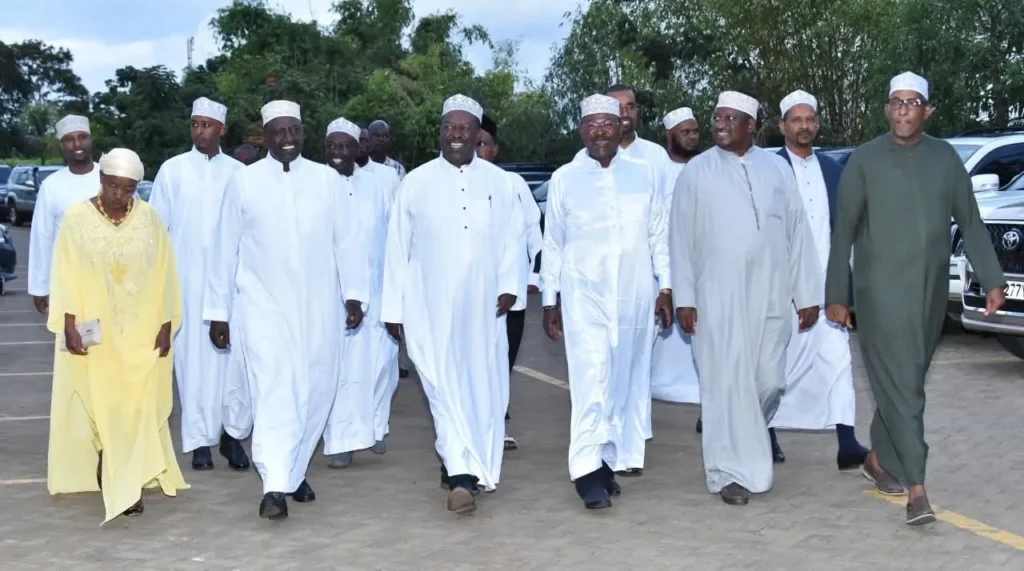
We request Chairman Abdullahi Abdi of NAMLEF to urgently convene a national forum. We call on CS Aden Duale, who has already courageously spoken out, to continue championing this cause in Cabinet and Parliament. We urge Muslim lawyers to explore all constitutional remedies, including review, repeal, or clarification of the ruling.
This is not the time for division. It is the time for unity.
This Is About the Soul of the Nation
The Supreme Court’s decision is a defining moment. Not just for Muslims, but for every Kenyan who values constitutionalism, diversity, and religious freedom.
Do we want a country where courts respect faith, or where faith is tolerated only when convenient? Do we want a future where pluralism thrives, or one where only one worldview is allowed?
This is not about inheritance. It is about identity. About justice. About the soul of our nation.
And we will not let it be betrayed.
References
https://x.com/ahmednasirlaw/status/1939927140775952780?t=9c6JU8J172fD5TEVI_8e6w&s=08
https://x.com/BillowKerrow/status/1940274900436210018?t=Q9HAFnSr37Is4RpOcs4nGg&s=08
We understand they want to target our daughters,wives and mothers to start think materiatistic but they will never succeed.
Stronger nations tried and failed,we will stand tall, resist and win.
The issue of inheritance for children born out of wedlock is never a matter of death in itself. Rather, the problem lies in several deeper factors:
First, we either misunderstand or remain ignorant of juristic perspectives on the matter.
Second, we fail to appreciate the true nature of Islamic law and its inherent flexibility.
Third, as a community, we struggle to distinguish between moral judgments and legal rulings.
Fourth, superficial religious markers—such as wearing a white robe or keeping a beard—are often mistaken for scholarly qualification in Islamic law.
Fifth, the average Muslim’s understanding of religious and legal matters is largely based on hearsay or uncritical repetition of what they hear from religious figures.
Sixth, many Muslims are hesitant to engage with less conventional viewpoints, preferring dogmatism over critical discussion.
Seventh, and most fundamentally: Who truly has the authority to speak on behalf of God?