A Nation on Its Knees, Grief, Courage, and the Cry for Justice in Kenya’s June 25 Tragedy
![People salvage steel from buildings torched during demonstrations to mark the first anniversary of the deadly 2024 antigovernment protests that drew widespread condemnation over the use of force by security agencies, in downtown Nairobi, Kenya, on June 26, 2025 [Thomas Mukoya/Reuters]](https://drmohameddahir.co.ke/wp-content/uploads/2025/06/2025-06-26T082328Z_1785412383_RC25AFA97GS9_RTRMADP_3_KENYA-SECURITY-PROTESTS-ANNIVERSARY-1750934942.webp)
There are days that break a nation’s spirit. June 25, 2025, will be remembered as one of those days for Kenya.
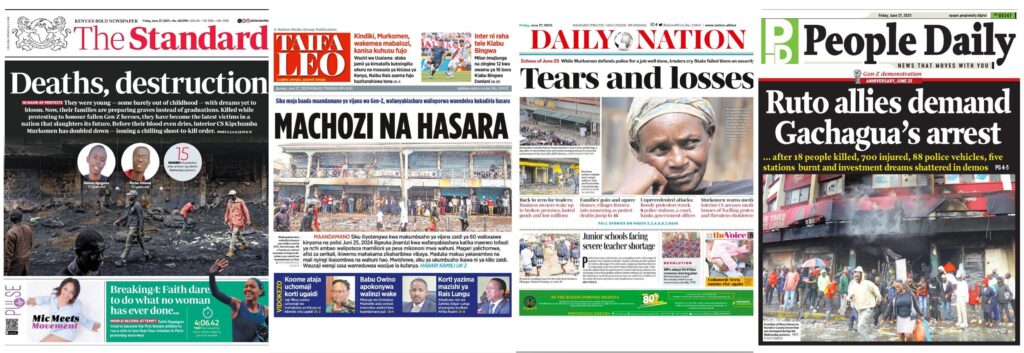
When I first saw the headlines this morning (27th June 2025) , I couldn’t look away. Eighteen lives lost. Over 400 people injured. A day meant to mark the memory of the dead turned into another page of bloodshed in Kenya’s story.
It’s not just the numbers. It’s what they represent, dreams cut short, families shattered, voices silenced. These were not criminals or threats. They were citizens, young, hopeful, and desperate to be heard.
They took to the streets to remember those who died exactly one year ago in similar protests. Back in 2024, over 60 people were gunned down as they opposed tax increases. This year, the call was the same: justice, accountability, and relief from economic hardship.
Instead, they got bullets.
![A man suspected of being a plain-clothed member of the Kenyan security forces is attacked by demonstrators marching in downtown Nairobi on June 25, 2025, during a planned day of protest [Tony Karumba/AFP]](https://drmohameddahir.co.ke/wp-content/uploads/2025/06/AFP__20250625__63NZ9JJ__v2__HighRes__TopshotKenyaUnrestPolitics-1750843448.webp)
A Peaceful Protest That Ended in Chaos
On Wednesday morning, protests began across several major cities, Nairobi, Mombasa, Kisii, among others. People gathered with flags and placards, chanting slogans like “Ruto Must Go” and “Occupy Statehouse.” They were emotional but largely peaceful in the beginning.
But in the heart of Nairobi, things spiraled quickly. Police had already cordoned off the State House and parliament with layers of barbed wire. Shops and schools were closed. There was fear in the air, fear that history might repeat itself.
And it did.
The police responded with more violence: live rounds, rubber bullets, tear gas, and water cannons.
Soon, what had started as a peaceful memorial became a scene of chaos. People ran for their lives. Some collapsed. Others fought back. In some areas, businesses were looted, and public buildings were set ablaze.
In Kikuyu, 20 kilometers from Nairobi, protesters torched government buildings including a police station and courthouse. Clashes were also reported in Machakos, Nyeri, and other regions. While cities like Mombasa remained calm, the damage across the country was already done.
Dr. Mohamed Abdidoor Dahir’s Response, A Voice of Conscience
Amid the confusion, one voice stood out for its clarity and compassion—Dr. Mohamed Abdidoor Dahir. As a respected public figure and moral leader, his response was firm, honest, and deeply emotional.
“We can’t just treat what’s happening in the country normally.”
Dr. Dahir didn’t ignore the damage caused by some protesters. He acknowledged that economic disruption was wrong. But he refused to justify the excessive force used by the police. He was deeply troubled by the loss of life, the trauma, and the fear gripping everyday Kenyans.
“At a moment when our country longs for unity, progress, and honest leadership, it’s disheartening to see actions that create unrest, even when done in the name of peaceful protests. We must be responsible citizens and those charged with public service must exercise restraint.”
His words weren’t political. They were personal. He spoke like a father would when watching his child suffer. With calm and purpose, he reminded us all that justice is not just about punishing violence, it’s about listening, understanding, and changing what led people to protest in the first place.
How Did We Get Here?
This tragedy did not come out of nowhere. It’s part of a much deeper crisis in Kenya. Young people are exhausted. The cost of living is rising. Jobs are scarce. Government corruption feels like a never-ending cycle.
And when peaceful means fail to bring change, frustration spills into the streets. For many Kenyans, especially the youth, protest has become the only language left to speak.
But what kind of democracy shoots its own people for speaking up?
Where Do We Go From Here?
Kenya stands at a crossroads.
One path leads to more violence, more suppression, and more fear. The other demands something much harder: real accountability, inclusive leadership, and meaningful reform.
Dr. Dahir’s message wasn’t just about this protest. It was a call for national healing. He asked leaders to stop hiding behind political narratives and face the reality, people are suffering, and they’re tired of being ignored.
What Kenya needs now is not more security forces in the streets. It needs listening ears in the halls of power.
Remember the Victims
Let’s not forget the human cost of this tragedy.
Behind every headline is a grieving mother, a missing brother, a shattered home. These are not strangers—they are Kenyans. Their blood now stains the pavement of our capital. Their pain should stain our conscience too.
It’s time we stop treating these deaths as statistics. They deserve more than that. They deserve justice, memory, and above all, change.
Dr. Dahir’s Hope for the Future
Despite everything, Dr. Dahir hasn’t given up hope. His words reminded us that even in pain, there is a path forward. A path of unity, not division. Dialogue, not violence.
He called for all leaders—whether in government or opposition—to put Kenya first. To remember that power without empathy is not leadership. It’s tyranny.
And for the youth, he offered encouragement: your voice matters. Don’t let fear silence you. But also, don’t let anger destroy you. Channel your pain into purpose. Demand your rights—but do so wisely, strategically, and peacefully.
Parting Shot
June 25, 2025, is not just a date on the calendar. It’s a wound in the heart of Kenya. But wounds can heal, if we let them. If we learn from them. If we stop pointing fingers and start holding each other accountable.
Kenya deserves better. And Dr. Dahir’s voice reminds us that better is still possible. But it won’t come from silence. It will come from compassion, courage, and the will to do what’s right, even when it’s hard.
Let’s not wait until the next tragedy to ask the hard questions. Let’s ask them now. And let’s answer with action.
Reference:
Photo Copied from – We are not the owners of the photos. https://www.aljazeera.com/news/2025/6/26/at-least-eight-killed-in-deadly-kenya-protests-what-we-know?utm_campaign=trueAnthem%3A+Trending+Content&utm_medium=trueAnthem&utm_source=facebook&fbclid=IwY2xjawLLAJJleHRuA2FlbQIxMQBicmlkETFDMEFwNUhFUkNEWGhLeW1wAR4coePCOVZMUpWKxAG-KaYtWNKGqp4SUzGiImIij_HpC5XMOvt2uHdSnj3hyw_aem_F4frExHHhwcWSU1_z9IS2w